#31 - 24HPC 2025 puzzles
Last year I had the pleasure to write a round for the 24 hours puzzle championship (24HPC) taking place after the WSPC in Eger, Hungary. I did this together with Chiel Beenhakker (bakpao) and Bram de Laat (Para), who are also both from the Netherlands. Our round consisted of a total of 30 puzzles: 15 standard types and 15 variations where a certain element (clues, cells, or objects) was enlarged. While there was no extremely difficult puzzle in the set, nobody managed to finish it (which is the goal for a 24HPC set), just because of the sheer volume of puzzles. Chiel's and Bram's puzzles (round 2), as well as all other rounds from the 24HPC can be found in the archive of chaotic_iak here, definitely worth checking out!
I definitely owe a lot of thanks to Bram and Chiel for this round. Due to a major deadline (handing in my PhD thesis) I did not have much time. They took quite some load off my hands by contributing more puzzles (12 each) and Chiel formatted everything by himself. The six puzzles I wrote can be found below. For each of the variations an example puzzle is provided as well.
1. Akari (5 points)
Just a simple puzzle with a clear theme as design to get the round started.
Place lights into some empty cells so that every cell is illuminated. Lights illuminate the cell they’re in as well as all cells seen in a straight line horizontally or vertically, not obstructed by a black cell. Lights may not illuminate each other. Clues represent the number of lights in the (up to) four cells surrounding the clue.

2. Akari (Large Bulbs) (30 points)
When thinking of this variant, I knew it would be nice to have another puzzle in the set that had large objects to be placed. While at first I tried it with the possibility to place 2x2 bulbs, this did not yield much new logic (and introduced lots of potential for non-uniqueness). At some point I finally realized that 1x2 bulbs would lead to a new solve experience for Akari.
Rules
Place lights of size 1x2 into some empty cells so that every cell is illuminated. Lights illuminate the cells they are in as well as all cells seen in a straight line horizontally or vertically, not obstructed by a black cell. Lights may not illuminate each other. Clues represent the number of lights in the (up to) four cells surrounding the clue.
13. Skyscrapers (30 points)

.png)
In general I like writing Skyscrapers for contests. I believe we also still wanted some number placement genre in the set, and Skyscrapers is what I could figure out a fitting variant for as well. Quite happy with the theming in this puzzle.
Place a number from 1 to N into each cell so that each row and column contains every number from that range with no repeats, where N is the side length of the grid. A clue outside the grid represents how many cells in the corresponding row or column contain a larger number than all cells before it in that row or column from the direction of the clue.

14. Skyscrapers (Large Clues) (35 points)
Rules
Place a number from 1 to N into each cell so that each row and column contains every number from that range with no repeats, where N is the side length of the grid. A clue outside the grid represents how many cells in the corresponding row(s) or column(s) contain a larger number than all cells before it in all row(s) or column(s) from the direction of the clue.

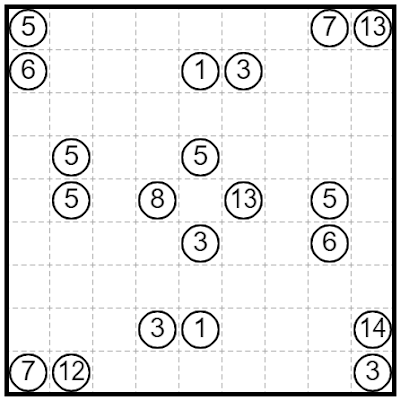
21. Country Road (25 points)
.png)
Very clear theme in this puzzle, which was trickier to get to work nicely than I anticipated. It feels like it did end up forcing a certain logical theme as well.
.png)
22. Country Road (Large Cells) (50 points)
Rules
Draw a non-intersecting loop through some cells that visits each cell at most once. Each region is visited exactly once. A number in a region represents how many cells in the region are visited by the loop. Orthogonally adjacent cells across a region border may not both be unused.
Large cells count as a single cell. If a large cell is used, the loop enters and exits the cell exactly once, after which the whole cell has been visited. How the loop is drawn within a large cell is irrelevant, as long as it is clear from which cell it is entered and to which cell it exits

.png)

.png)
Comments
Post a Comment