#30 - WSPC 2025 Recap & Practice puzzles
If you're here just for the practice puzzles, scroll all the way down to the bottom of this post. This post is also quite late after the WSPC, but I just did not have the time and motivation to finish up this post earlier.
This was my third time participating at the world championships, being part of the Dutch B-team for Sudoku and the Dutch A-team for Puzzles. In general, I immensely enjoyed this event. It was very well organized, went smoothly, and most puzzles were of very high quality! So huge credits to the organization and author teams for making this happen.
WSC 2025
Individual ranking: 82nd/252
Team ranking: 17th/63
It was a nice surprise to me that I placed top 100 in Sudoku, considering I had not solved many prior to this championship (as all my practice goes into WPC). I did love the variation between rounds, with several rounds feeling quite different from regular Sudoku. For me that's perfect, as the weirder or more puzzle-like it gets, the better I tend to be at it, but I can imagine that for true Sudoku enthusiasts some rounds felt too far removed from Sudoku.
Round 1 - Road to Eger!: 80/300 (138th)
Start of this round was alright for me, but completely messed up the 3rd sudoku: I went for the Cube Sudoku, but didn't realize until late that I was using the Surplus Sudoku to rule out digits for it, which I later heard more people got stuck on for a bit. I liked this round idea a lot though!
Round 2 - Classic Sprint: 35/200 (172nd)
These classics supposedly should have been easy, but I had a really hard time, but that was a general feeling that people had.
Round 3 - Parity Party: 145/400 (91st)
A fine round. I did spend a lot of time on the harder Different Parity Sudoku, but it also felt like my performance this round was according to my level in Sudoku.
Round 4 - Halved Squares: 270/500 (20th)
Absolutely loved this concept! For me one of the most fun rounds. Before the round I said to myself that I wasn't going to attempt the 145 point Killer, but when I looked at it, I saw the break-in immediately and it progressed quite smoothly, so it ended up being a good choice!
Round 5 - Small World: 195/390 (73rd)
Another very fun round idea. Finished the first set of linked Sudokus, looked a bit at the second set, but couldn't see anything quickly (and probably wouldn't have had enough time anyway). I also liked the addition of the irregulars, as it makes it less of an 'all or nothing' round. Probably should've skipped to the irregulars straight after the first set instead.
Round 6 - Calculated Fun: 210/450 (39th)
Math-heavy sudoku rounds are usually not my cup of tea, but I managed to solve 3 70-point puzzles (all of which were probably the least mathy of the round). In particular the Upper Right Heavy Killer Sudoku went very smooth.
Round 7 - Spot One!: 540/400 (70th)
Amazing round, but of course way too influential. Being 70th with 14 minutes to spare says enough. A mistake in this round would really ruin your tournament. Should have probably been valued with fewer points to compensate for the finishability of the round.
Team Round 8 - Circle of Sudoku: 1920/1800 (25th)
These kind of team rounds are always simple in concept, yet effictive in being a fun team round. We finished 6 minutes ahead of time, but unfortunately made minor mistakes in two grids, costing us quite some points.
Actually, an idea for a team round like this popped in my head about a week before the instruction booklet was launched, so it was fun to see it being implemented at this WSC.
Team Round 9 - The Patchwork Challenge: 1260/1800 (16th)
Really fun team round that required proper collaboration and communication. I feel like we would have finished a lot more with just a few more minutes more, but I am glad we managed to do decently at all with the mess of papers on the small tables.
Round 10 - Classic Uphill: 45/400 (196th)
While in the first classic round I had a hard time, here I simply did not see any logic. So at some point I just started bashing puzzles. Unfortunately just barely did not get the 55 pointer in time.
Round 11 - The Sudoku Pyramid: 78/300 (154th)
Really liked the idea behind this round. However, it turned out I didn't solve it strategically, as I had progress in all four grids, but did not end up with many points. Apparently I should have spent a bit more on the 6x6 or 9x9 to solve forwards or backwards without going back and forth all the time.
Round 12 - Sudoku Mix: 349/800 (55th)
Basically solved all the puzzles I liked in this round. A bit unfortunate for errors in 2 grids, but overall quite content with this round. In particular the Termination Sudoku was beautiful!
Team Round 13 - Weakest Link Revised: 1245/1800 (13th)
While in principle I like this concept, the team aspect is rather minimal. Each of our team members went at a rather similar pace, which helped it to go relatively smoothly. Personally just messed something up in the distance sudoku, else would have been able to finish that as well.
Team Round 14 - Utter Chaos: 1870/1800 (16th)
Fun idea for this round! Only thing is that the prints were a bit small, making it hard to work on it with four people at the same time. On the other hand, this may have stimulated to communicate better with eachother. We finished ahead of time but unfortunately made a small mistake somewhere.
WPC 2025
Individual ranking: 50th/267 (37th official)
Team ranking: 12th/67 (8th official)
First of all, I was so excited when the WPC IB came out. So many conceptually cool rounds, and many puzzle types I had not heard of before. This also motivated me to make quite a few practice puzzles. While the rounds were amazing (including in post-solving), it did not feel like a very good tournament for me. One of my strengths is that I make relatively few mistakes. However, during many rounds I was making simple mistakes while solving a puzzle, and I also had more mistakes in completed puzzles (e.g. a forgotten cell) than usual. Apart from finishing all sprint rounds, it also did not feel like I had any noteworthy round performance. All of this might in hindsight be explained by a general fatigue I was struggling with for a while already, but I was a bit bummed that it happened during such a fun WPC. Nevertheless, apart from some broken puzzles, the WPC was a total blast!
Round 1 - Welcome to Eger!: 390/700 (45th) - 9.75 pts/min
I was quite excited to get started with the WPC and the puzzles immediately proved gorgeous (I even wrote so on the booklet of round 2 already). Solving-wise could have done slightly better, but I always have to get into it a bit.
Round 2 - Evergreens: 865/1750 (53rd) - 10.81 pts/min
This round I was expecting to see weird stuff, as many people had said that the Evergreens round had trickeries to many standard puzzle types back in 2011. Apart from perhaps some 'hidden' cells in the Yajilin, there was not much trickery to be found. Nevertheless, the puzzles were lovely!
Round 3 - Hitori Variants: 230/950 (177th) - 4.6 pts/min
This was a disastrous round for me. After making a Fillomino + Hitori practice puzzle and solving a practice puzzle from Christian König in the morning, I was confident I would be able to tackle the Fillomino + Hitori, but also curious how they would make a nice puzzle without just using global deductions. Ofcourse the first Fillomino + Hitori already took me ages (I believe I miscounted which did not help), and yet I still made the mistake to try the second one for a bit. Also the Skyscrapers + Hitori (for which I made a practice puzzle) went weirdly. The first one I breezed through (similar break-in as my practice puzzle), but the second one I just kept breaking. In postsolving, I feel like the Nonconsecutive Hitori would have been way better to do, as those felt easier than the points suggested.
Round 4 - Quad Puzzles: 500/900 (39th) - 10 pts/min
Solid round; I solved what I wanted to solve. Love these types of puzzles with interconnected grids.
Round 5 - Fish & Ships: 465/500 (39th) - 10.33 pts/min
Massively enjoyed solving this round. While the instructions seemed a bit daunting at first, I looked forward to this round after trying the instruction puzzle. Funnily enough, during the contest I thought it would be possible that not all four grids connected together (e.g. there might be two islands of two grids). I even checked the rules during the competition and it did not state that all grids had to connect together. Perhaps I was still expecting some trickery after it did not happen in round 2.
The only downside of this round was that for some inexplicable reason I did not check my solution properly. With 8 minutes to spare, I checked the battleships, but decided not to check the anglers (a weird decision for my standards). After handing in, I immediately doubted the anglers therefore, and indeed, forgot to finish drawing a line to one of the fish, costing my an expensive 115 points.
Team Round 6 - Tapa Mastermind: CANCELLED
Lovely concept and in theory lovely puzzle, but sad that one wrong clue messed up the validity of this round.
Team Round 7 - Walk 2025: 1370/2250 (6th) - 45 minutes
On the one hand this seemed like a fun round to me, but on the other hand I was not looking forward to remembering the rules and colors of all the different walks. In the end the round went quite well, and it felt like we would have finished if we had 5-10 minutes extra. Unfortunately the way the scoring worked, we had quite some progress for certain puzzles, but just barely not enough in each subgrid in order to gain more points from it.
Round 8 - Across the Stars: 520/1150 (43rd) - 8.67 pts/min
Really fun round, it is always good to see mashups in a WPC. Aqre is one of my favorite puzzle types, but it is the one that messed up this round a bit for me. An early mistake in the 160 point Aqre only led to a contradiction all the way at the end of the solve, which had cost me a lot of time to fix. Without this mistake, this round would have probably been one of my best (non-sprint) rounds.
Round 9 - Assorted Puzzles: 625/1900 (81st) - 6.94 pts/min
This round I already expected not to do very well, as there were many types I was not necessarily looking forward to solving. Yet, it was still disappointing that I was getting stuck or making mistakes over and over in certain puzzles. The 115-point Binary Stars was stunning, one of the puzzles that I genuinely smiled at when unlocking its mysteries.
Round 10 - Nemo: 175/500 (138th) - 5.83 pts/min
Nemo is a type that is invented by Bram de Laat and has appeared in Dutch championships or at the website of WCPN before. Other people were asking me if I knew where they could find practice puzzles for Nemo, as they had barely found any online. Thus, one would expect me (and other Dutch people) to do relatively well here. However, my solving experience was a complete mess, breaking puzzles at the end, missing obvious deductions, etc... I must say that I also really do not like this presentation. Bram tends to use a regular square grid with light gray arrows in cells as clues. This is easy to write on top of with pencil, so I am not sure why this design choice was made for the WPC. Yet, this was not an excuse to do as poorly as I did.
Round 11 - Eger Castle: 510/450 (29th) - 12.75 pts/min
Relay puzzles are great fun to me, therefore I enjoyed this round a lot. It was also good to see that backsolving (from the final puzzle to Easy as 123) could really help here, as this makes it feel more interactive between grids, rather than just solving puzzles one by one.
Round 12 - Hexa Hungary: 520/400 (20th) - 14.86 pts/min
Lovely puzzle idea, and great execution. The second half of the puzzle went so much faster than the first half. I did end up using uniqueness sometimes to know what to look for, but with negative constraints (such as here on the arrows) it is always easy to mistakenly make uniqueness deductions. At the end I still had to fix a minor mistake, but after this was sorted I was able to hand it in well ahead of time.
Team Round 13 - Pangaea Proxima: 1730/2000 (12th) - 45 minutes
Permaculture is perhaps one of my favorite mashup types, and I solved a lot of them on Logic Masters Deutschland. This round went rather smoothly for me personally (never felt stuck). Interestingly, we did get all the puzzle pieces at the end without solving all individual puzzles (we only found the border for one of them). Great round and great round concept, I only think that it should have been more easy to finish this one. Don't get me wrong, I like it when not every team round is easily finishable by most A teams, but after going through the effort of 3D printing the puzzle pieces, it is a shame so few teams actually got to that stage.
Team Round 14 - Solar System: 2220/3000 (16th) - 75 minutes
Absolutely insane round concept and presentation. These grids ofcourse allow for solving mistakes very easily, so we ended up solving in duos quite a bit. Unfortunately, it cost Bram and me a lot of time to figure out we indeed did not make a mistake on the Fillomino, it just had multiple solutions.Yet, this was probably the most creative and mind-bending WPC round I have experienced (in my 3 years of experience).
Round 15 - Singularity: 405/900 (48th) - 8.1 pts/min
Great round concept, but I was also very curious what certain puzzle types were going to be like (e.g. Compass). Especially missing one particular possibility in the Bosnian Road cost me a lot of time in this round.
Round 16 - Coded Puzzles: 610/750 (44th) - 10.17 pts/min
Another great round concept, and it felt like it was a bit of a sprint round, even though it wasn't labelled this way. Unfortunately, I forgot 1 shaded cell in the Tapa and just barely didn't get the Arithmetic Square in time, but I had a lot of fun throughout.
Round 17 - The Casino: 540/1050 (61st) - 7.71 pts/min
Weird and fun round at the same time. I practiced Dice Poker a lot (through creating practice puzzles). While some of those went super smoothly, I completely messed up some others (including one where I solved it fully after an early counting mistake (16 is not 17)). Darts, a puzzle type I am usually not fond of, were actually surprisingly beautiful to solve.
Round 18 - Full Loops: 700/600 (15th) - 14 pts/min
The fact that this was the final round was perfect. It felt so good to end with a round where going through puzzles felt speedy. I could have even been faster, because I kind of forgot for a while that all cells need to be used in every puzzle.
Practice puzzles
As I was quite excited for the novelty in many of the rounds, I ended up creating quite some practice puzzles for the WPC. Most puzzles should have medium difficulty, although some are a bit harder.
Skyscrapers + Hitori (round 3, puzzles 10/11)
The first puzzle of the contest used very similar logic to this puzzle, allowing me to solve a 45 pointer in ~2 minutes. Sadly I completely messed up the second puzzle, costing a lot of time.
Rules
Shade some cells so that in the unshaded cells, no number is repeated in any row or column. Shaded cells cannot share an edge. All unshaded cells form one connected group.
When only considering the unshaded cells, the numbers outside the grid represent Skyscraper clues, i.e. how many unshaded cells in the corresponding row or column contain a larger number than all unshaded cells before it in that row or column from the direction of the clue.
.png)
Fillomino + Hitori (round 3, puzzles 14/15)
It took me a lot of effort to come up with a unique puzzle that had interesting logic that was not bypassable, without resorting to global counting logic. Perhaps this should have been a first hint of what the contest puzzles were going to look like...
Rules
Shade cells according to Hitori rules. Then divide the unshaded cells into regions so that no two regions of the same size share an edge. Any number in an unshaded cell must be equal to the area of the region it belongs to. A region can contain zero, one or more of the remaining numbers in unshaded cells. Numbers in cells that end up shaded bear no information.
.png)
Hungarian Numberlink (round 9, puzzles 15/16)
I like this a lot more than standard Numberlink. The puzzle I came up with is based on something funky I thought would perhaps appear during the championship, which it did not. However, it did help me a lot to understand the main concepts of this puzzle type.
Rules
Draw some paths into the grid so that the two endpoints of every path are on cells with numbers. Each number must be the endpoint of exactly one path. The paths do not cross or overlap themselves or each other, and together they use every cell exactly once. For each path, the number of cells where the path goes straight through the cell must match the number at one endpoint of the path, and the number of cells where the path makes a turn must match the number at the other endpoint of the path.
%20(1).png)
Binary Stars (round 9, puzzles 25/26)
Funny thing: I did not actually read the rules properly before creating a practice puzzle, so made a binary stars with two stars per row and column first. After I realized this, I still had to make a normal one as well. The 115 point binary stars in the competition probably was my favorite puzzle of this round. The 30 point one I somehow messed up over and over before finally realizing what I was missing.
Rules
Place stars into some cells so that each row and each column contains exactly one (1) star (two (2) stars for the second puzzle of mine!). No two cells with a star share a corner. It is allowed to place a star into a cell that has a dot inside or on its perimeter. For any pair of two stars, their midpoint is defined to be the location that is on a straight line connecting the centres of those two stars and is exactly the same distance away from the centres of those two stars. Some black dots are provided on the grid; each one must be a valid midpoint (but can be the midpoint of more than one pair of stars). Not all possible midpoints are necessarily given.
%20(1).png)

Singular Cave (round 15, puzzles 1-3)
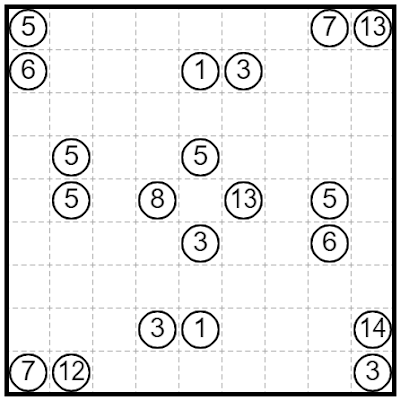
I was quite excited to see this concept for the round, as I had already explored it for cave five years prior with 'all 2s and 3s given' (see that puzzle on LMD here).
Rules
Shade some cells so that all unshaded cells are connected, and all shaded cells are connected to the border of the grid. Cells with numbers cannot be shaded. Numbers indicate the total count of unshaded cells that can be seen in all four directions, including the numbered cell itself. Every cell that is unshaded in the final solution and could contain the singular number as a valid clue actually contains that number.
%20(2).png)
Singular Akari (round 15, puzzles 4-6)
Especially for Akari I think this rule can really spice up the genre a bit!
Rules
Place light bulbs in some of the unshaded cells so that in the end all unshaded cells are illuminated. Each bulb illuminates the cell it is in, as well as all cells it sees in a straight line horizontally or vertically. Black cells obstruct visibility. No bulb can illuminate another bulb. Numbered black cells indicate how many of their orthogonally adjacent unshaded cells contain bulbs. Every black cell that could contain the singular number as a valid clue actually contains that number.
%20(2).png)
Singular Skyscrapers (round 15, puzzles 7-9)
Actually appeared to be not unique after several tries of shuffling clues around to make it work. Should be good now after some post-WPC edits though!
Rules
Enter a number from 1 to N into every cell, where N is the size of the grid, so that no number repeats in any row or column. Numbers outside the grid indicate how many cells in the corresponding row or column contain a larger number than all cells before it in that row or column from the direction of the clue.
Every cell inside or outside the grid that could contain the singular number either as a valid clue or as part of the correct solution actually contains that number.
%20(1).png)
Singular Compass (round 15, puzzles 13-15)
This was already quite tricky to get unique, so I could not imagine how hard it would be for a puzzle with clues of 2 or higher.
Rules
Divide the grid into regions of orthogonally connected cells, each containing exactly one compass. Each compass is divided into four quadrants, corresponding to the four cardinal directions: North (up), East (right), South (down) and West (left). A number in a compass quadrant indicates how many cells in its region lie further in that cardinal direction than the compass itself.
Every compass quadrant that could contain the singular number as a valid clue actually contains that number.
%20(2).png)
Singular Bosnian Road (round 15, puzzles 16-18)
This was one of the singular puzzles that felt most natural to me, although getting a unique solution could still be tricky here as well.
Rules
Draw a closed loop into the grid that runs horizontally and vertically and passes through each cell at most once. The loop cannot pass through cells with numbers. Cells occupied by the loop cannot share a single point (except if they are at most two cells away from each other when travelling along the loop); in other words, the loop cannot touch itself, not even diagonally. The numbers indicate how many horizontally, vertically and diagonally neighbouring cells (out of up to 8) are used by the loop.
Every cell that is unshaded in the final solution and could contain the singular number as a valid clue actually
%20(3).png)
%20(4).png)
Dice Poker (round 17, puzzles 12-16)
I wanted to prepare well for Dice Poker, since almost half of the points of the round were to be earned with these puzzles. I am quite happy with the puzzles, even if they were made to be quite challenging. The second also helped a lot with a high point Dice Poker in the contest, so it was all worth it.
Rules
Enter exactly one number from 1 to 6 into each empty cell. Numbers of the left and top indicate the sum of the numbers in that row, column or the main diagonal. Numbers on the right and bottom indicate the strongest dice poker combinations in that row, column or the main diagonal.
%20(2).png)
%20(3).png)

.png)
Comments
Post a Comment